Why Do Japanese People Sleep on the Floor? Walk into a traditional Japanese home, a ryokan inn, or a tatami-floored guest room. And you’ll likely find no bed frame at all. Just a thin mattress laid directly on woven straw matting. For visitors from countries where a raised bed is the default, it’s a striking difference. And one with real history, practicality, and even some genuine health reasoning behind it. It’s worth noting upfront that this is a traditional practice rather than a universal one. Many households in Japan today use Western-style beds, and floor sleeping exists alongside them as a living cultural tradition. Rather than the only way people sleep.
The Basics: Futon and Tatami
What’s commonly called a “Japanese futon” is different from the folding Western sofa bed also called a “futon”. The traditional setup involves two main elements:
- Tatami — floor mats traditionally woven from rush grass, used as flooring throughout much of a traditional Japanese home
- Shikibuton (敷布団) — a thin, firm cotton mattress laid directly on the tatami, paired with a kakebuton (掛布団), a comforter-style cover on top
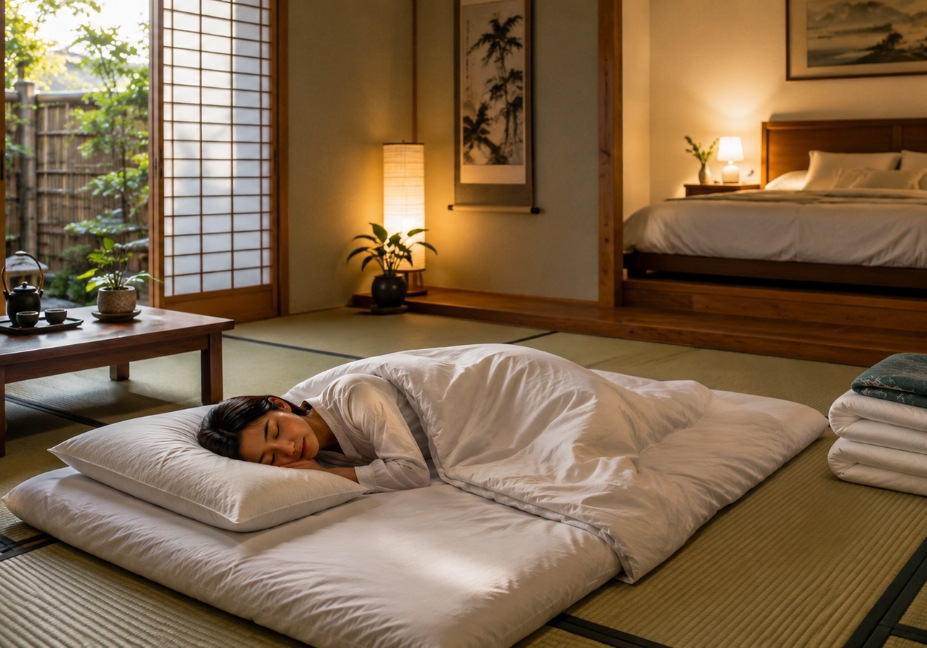
Unlike a Western mattress that stays put in a bedroom, a shikibuton is designed to be rolled. Or folded up and stored away each morning. Often in a built-in closet called an oshiire. This transforms the room. A bedroom at night becomes an open living or dining space during the day. Which historically made it possible for a single room to serve multiple purposes.
A Practice Rooted in Centuries of History
Evidence of sleeping on woven floor mats in Japan dates back roughly a thousand years. Though the cotton-filled futon most people picture today didn’t become widespread in ordinary homes until the 20th century. Earlier versions were often reserved for wealthier households. Some historical accounts also connect the custom to the arrival of Buddhism in Japan in the 6th century. Which influenced ideas of simplicity and minimal material possessions that carried into how homes were furnished.
Why Do Japanese People Sleep on the Floor?
Did you know? The oldest surviving bed in Japan is said to have belonged to Emperor Shōmu in the 8th century. A reminder that raised beds existed in Japan long before the futon-and-tatami system became the common household standard.
Practical Reasons: Space, Flexibility, and Cost
For centuries, especially in smaller homes and apartments, floor sleeping has offered genuine practical advantages:
- Space efficiency. A room used for sleeping at night can become a living. Or dining space by day once the futon is folded away. Valuable in a country where urban housing has long been compact.
- Flexibility. Futons can be added or removed easily to accommodate guests, growing families, or changing needs. Without the commitment of a permanent bed frame.
- Affordability. A shikibuton is generally far less expensive than a Western-style mattress. And bed frame, making it an accessible option across income levels.
- Multiple sets for different seasons. It’s common for households to rotate between thinner futons for summer and thicker, warmer ones for winter.
The Health Angle
Alongside tradition and practicality, floor sleeping is widely associated in Japan with certain health beliefs. Some are better supported by evidence than others:
- Spinal alignment. A firm, flat sleeping surface is thought to help keep the spine in a more neutral position compared to a soft, sagging mattress. A 2005 clinical study on mattress firmness and chronic back pain lent some support to the idea that firmer surfaces can benefit certain people with back pain, though sleep surface preference still varies significantly from person to person.
- Temperature regulation. Since warm air rises, sleeping closer to the floor can feel cooler, which is part of why the futon-and-tatami system has traditionally suited Japan’s hot, humid summers.
- Airflow and moisture control. Tatami is a breathable, natural material, and airing futons out in sunlight is beneficial. A near-daily ritual in many households — it helps prevent moisture buildup and mould, an important consideration in Japan’s humid climate.
Expert note:
Traditional futon care specifically emphasises airing the mattress in sunlight and not leaving it on the tatami all day. Since trapped moisture between the two surfaces can encourage mould growth. This daily maintenance ritual is part of why many traditional Japanese homes are built with south-facing balconies, to make regular airing convenient.
A Cultural Aesthetic, Too
Beyond the practical and health-related reasons, floor sleeping fits within a broader aesthetic of simplicity and minimalism that runs through many aspects of traditional Japanese interior design — floor seating for meals, low tables, and tatami rooms designed for flexible, multi-purpose living. For many households, the appeal isn’t only about function; it’s also about a calmer, more grounded way of using domestic space.
Why Do Japanese People Sleep on the Floor?
Is Everyone in Japan Sleeping on the Floor?
Not necessarily. Western-style beds have become increasingly common in Japan, particularly in newer apartments and among younger generations, and many households mix both – a bed in one room and tatami and futons in another for guests or traditional use. Ryokans (traditional inns) and homes that maintain tatami rooms continue to keep the futon system very much alive, and it remains a meaningful part of Japanese domestic culture rather than a historical relic.
What About Trying It Yourself?
Floor sleeping has drawn interest outside Japan too, particularly among people exploring minimalist design or looking for a firmer sleep surface. A few things worth knowing if you’re curious:
- It’s not just a mattress on a bare floor. The traditional system layers a breathable base (tatami or a slatted platform as a substitute), a firm but flexible mattress, and natural bedding on top — simply placing a mattress directly on a hard floor skips the airflow benefits of the original design.
- Adjustment takes time. People accustomed to thick, plush mattresses often find the transition to a firmer surface takes some getting used to.
- It isn’t universally the better option. Comfort with a firm sleep surface varies by individual body type. And any existing back or joint conditions. It’s a personal fit question, not a one-size-fits-all health upgrade.
Frequently Asked Questions
Why do Japanese people traditionally sleep on the floor instead of beds?
It’s a mix of centuries-old tradition, space efficiency in smaller homes, and affordability. And beliefs about spinal health and temperature regulation tied to Japan’s humid climate.
What’s the difference between a Japanese futon and a Western futon?
A traditional Japanese futon (shikibuton and kakebuton) is a thin cotton mattress-and-cover set placed directly on tatami flooring. And stored away during the day. A Western futon typically refers to a folding sofa-bed frame, which is a different product entirely.
Is sleeping on a futon actually better for your back?
Some research supports firmer sleep surfaces for certain people with chronic back pain, but comfort and benefit vary by individual. It isn’t a universal improvement for everyone.
Do all Japanese people still sleep on the floor today?
No. Western-style beds are increasingly common in Japan. Especially in newer homes and among younger generations. Though tatami rooms and futons remain culturally significant and widely used, particularly in traditional settings like ryokans.
Why do futons need to be aired out regularly?
Because tatami and futon material can trap moisture. Especially in humid climates, regular airing in sunlight helps prevent mould. And keeps the sleeping surface fresh and hygienic.
The Bottom Line
The tradition of sleeping on a futon atop tatami flooring in Japan reflects a genuine blend of history and practicality. And health-conscious design – built for compact living and a humid climate. And a broader cultural preference for simplicity. While Western-style beds have become increasingly common across Japan, the futon-and-tatami system. Remains a living, actively maintained tradition rather than a thing of the past.
This article is for general cultural and informational purposes. It does not substitute for professional medical advice on sleep surfaces or back health, which can vary significantly by individual.