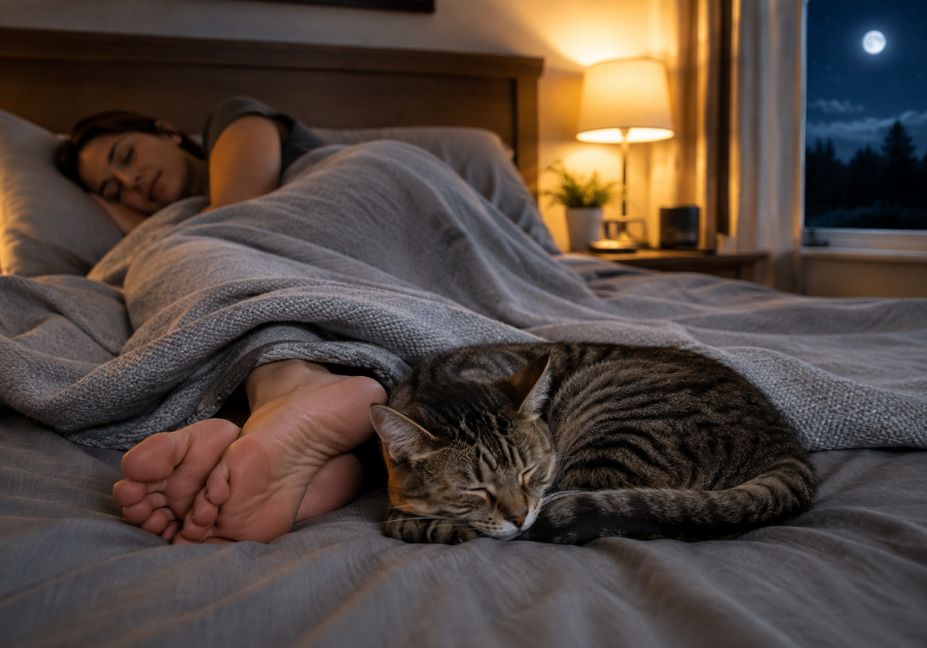
There’s something quietly comforting. About waking up to find your cat curled at the foot of the bed, night after night. It’s such a consistent habit for so many cats that it’s earned its own body of folklore and spiritual interpretation. Alongside some genuinely interesting feline behaviour science. Why does my cat sleep at my feet? Whether you’re drawn to the symbolic side of this habit or want to understand. What’s actually going on in your cat’s head? Here are both sides of the story.
Spiritual and Folklore Interpretations
Cats have held a symbolic, sometimes mystical, place in human culture for thousands of years. And many spiritual traditions and modern intuitive practices have their own take on it. Why a cat might choose to sleep at your feet. It’s worth being clear upfront: these are beliefs and folk traditions, not scientific claims. But they’re meaningful to many people who feel a spiritual connection with their pets.
- A symbol of trust and protection. In many of these traditions, a cat is sleeping at your feet. Rather than, say, your chest or face — is seen as an act of quiet guardianship. Keeping watch over you while you’re at your most vulnerable.
- Energetic grounding. Some spiritual frameworks describe cats as sensitive to subtle energy, with the idea. That a cat resting at your feet is helping to “ground” or stabilise your energy. Particularly at the end of a stressful day.
- A protective presence during sleep. In some belief systems, cats are thought of as watchful companions during the vulnerable, unconscious hours of sleep. A modern echo of much older cultural traditions. That associated cats with keeping watch over the threshold between waking and dreaming.
- A sign of deep bonding. Many who follow these traditions interpret consistent foot-sleeping as a cat choosing you specifically, night after night, as their person.
Worth knowing: These interpretations vary widely between traditions and individual practitioners, and there’s no single agreed-upon “meaning”. If this resonates with you, it can be a meaningful lens for thinking about your relationship with your cat — just know it reflects belief and tradition rather than established science.
What Actual Feline Behaviour Research Says
Alongside the folklore, there’s a well-documented, practical explanation for this habit rooted in real cat behaviour and biology.
Warmth
Cats are drawn to heat, and your body radiates a steady, reliable source of it. The end of the bed near your feet offers a consistently warm spot without disturbing you as much as curling up on your chest or face would. Since cats regulate body temperature differently than humans and benefit from staying warm, seeking out a heat source during sleep is a genuinely practical choice on their part.
A Balance of Closeness and Independence
Unlike dogs, who often want maximum physical contact, cats tend to balance affection with a need for personal space. Sleeping at your feet offers closeness without confinement — close enough to stay connected to you, but with enough room to move, stretch, or leave without disturbing you if something catches their attention.
Did you know? Cats are prey animals as much as they are predators, and that instinct doesn’t disappear with domestication. Sleeping at the end of the bed, rather than somewhere more enclosed, gives a cat a clear sightline and a fast escape route — a small but real echo of the caution wild cats rely on when choosing where to rest.
Trust and Routine
A cat that consistently chooses to sleep near you, rather than alone in another room, is generally showing a real sense of security in your presence. Cats value consistency, and a stable nightly sleeping spot — whether that’s your feet, a favourite chair, or a windowsill — is often as much about routine and comfort as it is a specific statement of affection.
Scent Familiarity
Your feet and the end of the bed carry your scent strongly, and cats find familiar scents comforting. Sleeping in a spot saturated with your scent can be part of what makes it feel safe and appealing, separate from warmth or closeness alone.
Pro tip: If your cat suddenly stops sleeping at your feet after doing so consistently or starts sleeping in unusual places like a litter box, it can sometimes reflect stress or a change in their environment. A sudden, unexplained shift in sleeping habits is worth a closer look and a vet visit if it persists.
So, Which Explanation Is Right?
Both can be true at once, depending on what you’re looking for. The behavioural explanation — warmth, safety, routine, and trust — is well supported by what’s known about cat behaviour and doesn’t require choosing between “instinct” and “affection”, since for cats, the two are often the same thing. The spiritual interpretations layer meaning on top of that behaviour for those who find value in that lens, and neither one has to cancel out the other: a cat seeking warmth at your feet can still be a real, felt expression of trust and connection, however you choose to understand it.
Frequently Asked Questions: Why Does My Cat Sleep at My Feet
What does it mean spiritually when a cat sleeps at your feet?
In many spiritual traditions and modern intuitive beliefs, it’s interpreted as a sign of protection, trust, or energetic grounding. These are beliefs rather than established facts, but they hold real meaning for many cat owners.
Why does my cat specifically choose my feet instead of somewhere else on the bed?
Practically speaking, it’s often a mix of warmth, a clear sightline for staying alert, and closeness without feeling confined — a comfortable middle ground between full contact and independence.
Is it a sign of trust when a cat sleeps near you?
Generally, yes. A cat that consistently chooses to sleep close to you, rather than avoiding you or sleeping elsewhere, is typically showing that they feel safe and secure in your presence.
Should I be concerned if my cat suddenly stops sleeping at my feet?
A sudden, lasting change in sleeping habits can sometimes reflect stress, illness, or a change in environment. If it persists or comes with other behaviour changes, it’s worth mentioning to your veterinarian.
Do all cats like to sleep at their owner’s feet?
No — cat sleeping preferences vary a lot by individual personality, and some cats prefer sleeping on your chest, beside you, or in an entirely separate spot. There’s no single “correct” sleeping position that all cats share.
The Bottom Line
Whether you find meaning in the spiritual symbolism of a cat choosing to sleep at your feet, or you’re more drawn to the biology of warmth-seeking and trust-building, both perspectives point to the same underlying truth: your cat has chosen to be close to you, night after night. That consistency — spiritual sign or simple feline comfort-seeking — is worth appreciating either way.
This article blends folklore and spiritual traditions with general behavioural information about cats and is intended for informational and entertainment purposes. It does not substitute for professional veterinary advice. If you have concerns about a change in your cat’s behaviour, consult your veterinarian.