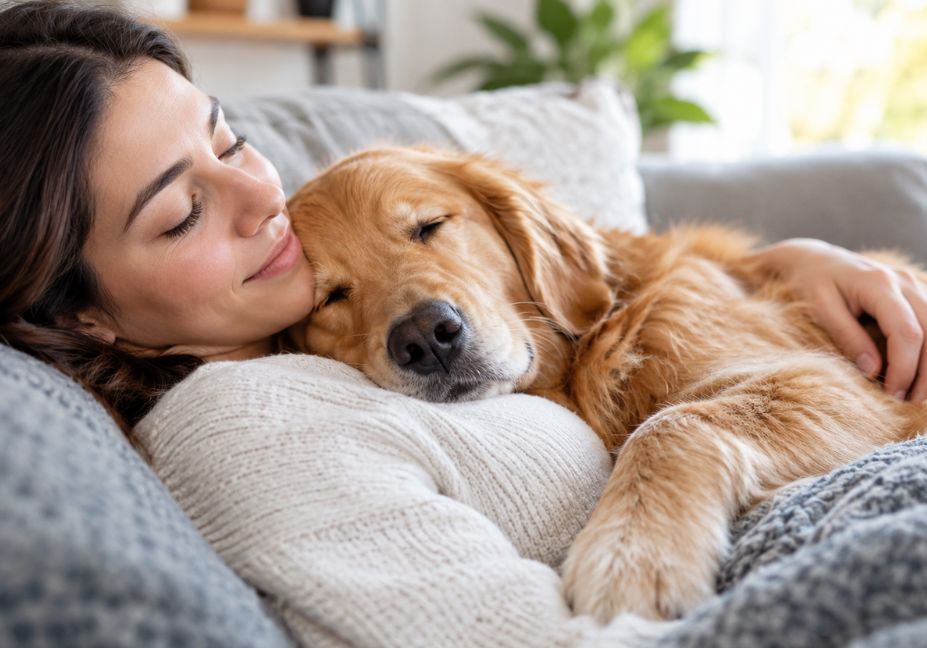
Why Does My Dog Like to Sleep on Me? You go to bed with plenty of open mattress. And somehow you still wake up pinned under 40 pounds of dog. If that sounds familiar, you’re in good company — roughly half of dog owners share a bed. Or couch with their pet, and plenty more get “slept on” even when there’s a perfectly good dog bed nearby. It can feel flattering, a little uncomfortable, and occasionally confusing all at once. So what’s actually going on?
The short answer: Your dog sleeping on you is almost always a good sign, rooted in instinct, biology, and genuine affection. Here’s the fuller picture, including the handful of situations where it’s worth paying closer attention.
It starts with pack instinct.
Dogs are descended from highly social ancestors that slept in close-contact groups for warmth and protection. Sleep is when an animal is at its most vulnerable, so they pile up together. The way a litter of puppies curls up with their mother and littermates offers real safety in numbers. Domestic dogs still carry that wiring. When your dog treats you as part of their pack, sleeping pressed against you (or on top of you) is simply the instinctual move. Whether or not there’s any actual danger around.
Body Heat, Comfort, and a Better Bed
Some of it is refreshingly practical. Dogs run slightly warmer than humans. But they still appreciate an extra heat source, especially on a cold night. And you happen to be a warm, breathing radiator. Your bed or couch is also usually softer, roomier, and comfier than most dog beds, which doesn’t hurt either.
Trust, Security, and the Oxytocin Connection
Because sleep leaves any animal exposed, choosing to sleep on a specific person is a meaningful signal of trust. Your dog is essentially saying. ‘I feel safe enough with you to be unguarded.’ Some of the most vulnerable-looking sleep positions — on their back, belly exposed, paws in the air — are considered strong indicators of comfort and security specifically. Because that pose leaves them least able to react quickly.
There’s a biological layer here too. Close physical contact between dogs and their owners — petting, cuddling, eye contact — triggers the release of oxytocin, often nicknamed the “love hormone”, in both species. It’s the same hormone involved in the bond between a parent and infant. That shared oxytocin response is a big part of why co-sleeping tends to deepen the connection between a dog and their favourite person, and it can even lower blood pressure and stress in both of you.
Did you know? In multi-person households, dogs often gravitate toward sleeping on whichever person gives them the most attention or has built the deepest day-to-day relationship with them—not necessarily the person who feeds them.
Is It Ever a Problem?
For most dogs, sleeping on you is simply affection plus instinct, and it’s not something to worry about. That said, a few patterns are worth watching:
- A sudden change. If a dog who never used to sleep on you abruptly starts insisting on it. Especially alongside pacing, whining, or distress when you’re out of sight. It’s worth considering separation anxiety or even an underlying health issue rather than assuming it’s “just cuddling”.
- Resource guarding or possessiveness. A dog that becomes stiff, growly, or snappy when you try to move, or when another person or pet approaches while they’re sleeping on you, is showing something closer to guarding behaviour than simple affection.
- Difficulty settling anywhere else. If your dog seems unable to relax or sleep at all unless in direct contact with you, that clinginess can be worth mentioning to a vet or trainer, particularly if it’s paired with distress during normal separations, like you showering or stepping outside.
Expert note: Veterinary behaviour sources are clear that sleeping in your bed does not cause separation anxiety. The condition has more to do with genetics and early experiences. And how a dog was (or wasn’t) taught to be comfortable with independence. A dog with existing separation anxiety may simply be more motivated to stay glued to you at night, causing an effect running in the opposite direction from what many people assume.
Why Does My Newborn Fight Sleep?
Do You Have to Let Your Dog Sleep on You?
Not at all — and there’s no harm in setting a different arrangement if being slept on isn’t working for you. A comfortable dog bed placed near your bed can offer a lot of the same closeness and security without the physical weight. Positive reinforcement (rewarding your dog for settling on their own bed) tends to work far better than pushing them away in the moment, which can feel confusing or even punishing to a dog who’s just trying to be close to you.
Frequently Asked Questions
Is it bad to let my dog sleep on me every night?
No — for most dogs, this is a normal expression of trust and comfort-seeking. And bonding, and there’s no evidence that it causes behavioural problems on its own.
Why does my dog only sleep on one specific person in the house?
Dogs often form their strongest sleep-time attachment to whoever spends the most quality time and attention on them day to day, not necessarily the person who feeds or walks them.
Does letting my dog sleep in my bed cause separation anxiety?
No. Veterinary behaviour experts have found no evidence that bed-sharing causes separation anxiety. Dogs that already have separation anxiety may simply seek out extra closeness at night as a coping strategy.
What does it mean if my dog sleeps on their back with their belly exposed?
This is generally considered one of the clearest signs of trust and relaxation. It’s the most physically vulnerable sleep position a dog can take.
Should I be worried if my dog suddenly wants to sleep on me and is never used to it?
A sudden change in sleeping habits is worth noticing. If it comes with other new behaviours — distress when alone, pacing, appetite changes. It’s reasonable to check in with your vet to rule out anxiety or a health issue.
The Bottom Line
When your dog chooses to sleep on you. They’re drawing on instincts that go back to their earliest ancestors, seeking out your warmth. And reinforcing a bond that runs on the same “love hormone” that connects human parents and children. For the overwhelming majority of dogs, it’s simply their way of saying you’re their person — cramped mattress and all.
This article is for informational purposes only and does not substitute for professional veterinary or behavioural advice. If you have concerns about your dog’s anxiety or behaviour, consult your veterinarian or a certified dog behaviourist.