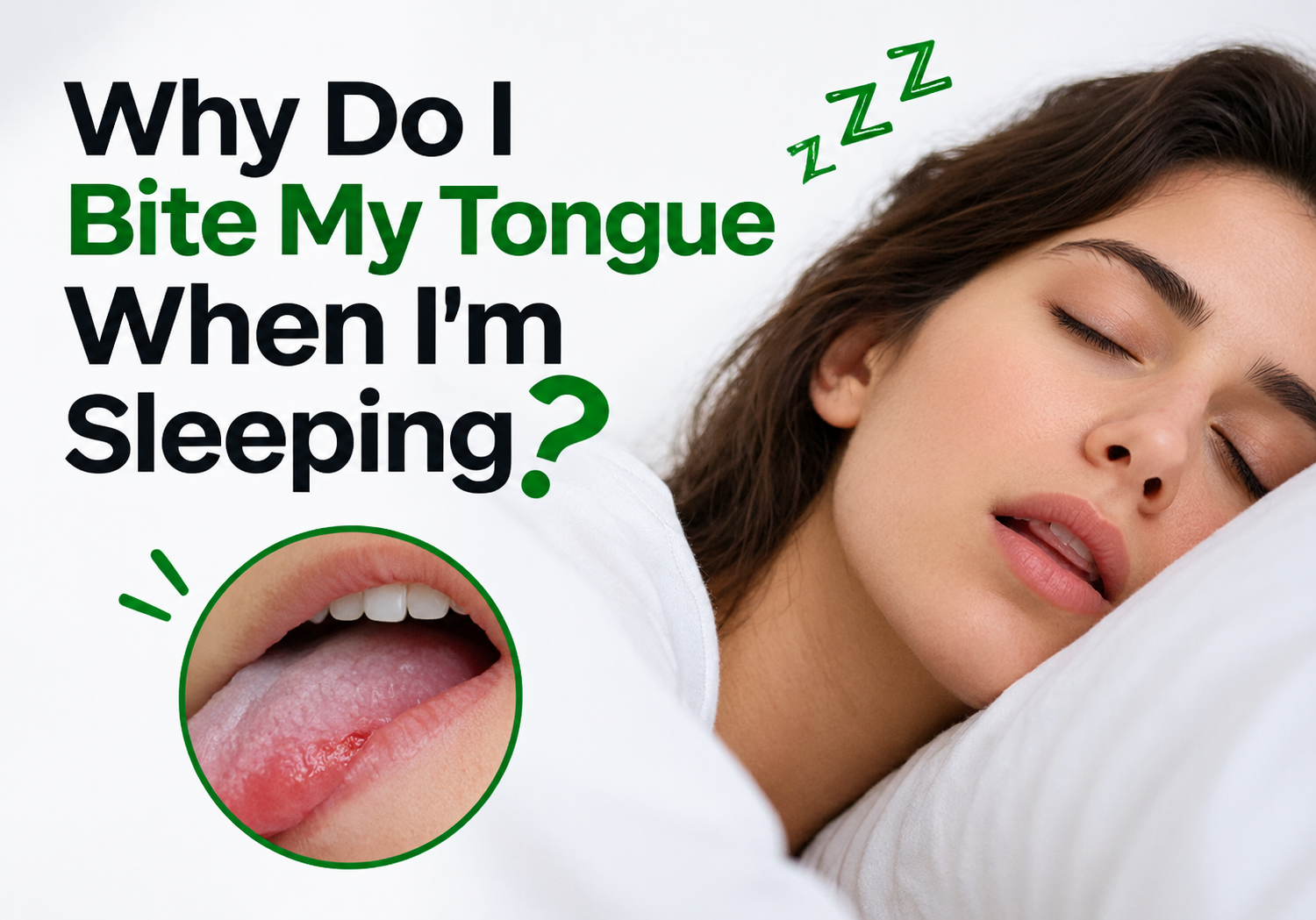
Why Do I Bite My Tongue When I’m Sleeping? Waking up to a sore, swollen, or bleeding tongue is a strange kind of alarming — you clearly hurt yourself, but you have no memory of how. Nighttime tongue biting is more common than most people realise, and in the large majority of cases it comes down to something very treatable: teeth grinding. But a smaller number of cases point to something that deserves a closer look, including nocturnal seizures. Here’s how to sort out which one you’re dealing with.
The Most Common Cause: Sleep Bruxism
Bruxism — involuntary grinding or clenching of the teeth — is by far the most frequent reason people bite their tongue overnight. As the jaw grinds or clenches, it can shift just enough for the tongue to get caught between the teeth. Sleep bruxism is common: it’s estimated to affect nearly half of children at some point, along with roughly 8% of middle-aged adults and about 3% of older adults.
Signs that bruxism, rather than something more serious, is behind your tongue biting include:
- A sore or swollen tongue, cheek, or jaw upon waking
- A scalloped tongue — small indentations along the edges from repeated pressure against the teeth
- Jaw soreness or headaches, particularly around the temples, in the morning
- A partner who mentions hearing grinding sounds at night
Did you know? Stress and anxiety are two of the most common triggers for sleep bruxism, which is part of why grinding and tongue biting often flare up during especially demanding periods of life.
Other Common (and Usually Manageable) Causes
- Misaligned teeth (malocclusion). When teeth don’t line up properly, the tongue can sit awkwardly in the mouth or get trapped between teeth more easily during any nighttime jaw movement.
- Obstructive sleep apnoea. People with sleep apnoea often have a larger tongue or more relaxed mouth muscles, along with abrupt jaw movements during apneic episodes — both of which raise the odds of a nighttime bite. Snoring, gasping, morning headaches, and daytime fatigue are common companion symptoms.
- Medications. Certain medications for mental health or neurological conditions can cause involuntary muscle movements or altered sleep patterns as a side effect. If tongue biting started around the time you began a new medication, it’s worth mentioning to the prescribing doctor.
- Facio-mandibular myoclonus (FMM). A less common sleep disorder involving sudden, forceful jaw and facial muscle contractions, which can look similar to nocturnal seizures but has a different underlying cause.
- Rhythmic movement disorder. More common in children, this involves sudden jerking movements of the head and neck during sleep that can occasionally result in a tongue bite. Kids typically outgrow it.
Why Do I Bite My Tongue When I’m Sleeping?
Pro tip: A custom night guard, fitted by a dentist, is one of the most effective ways to protect your tongue and teeth from bruxism-related biting while any underlying trigger — stress, misalignment, sleep apnoea — gets addressed.
When It Might Be a Nocturnal Seizure
This is the possibility worth taking seriously. Certain seizure types, including some forms of epilepsy that occur specifically during sleep, can cause involuntary jaw clenching severe enough to cause a deep tongue injury.
A few details can help distinguish seizure-related biting from ordinary bruxism:
- Location of the bite. Seizure-related tongue injuries are more often on the sides of the tongue, while bruxism-related soreness tends to be more generalised.
- Severity. Seizure bites tend to be deeper cuts rather than mild soreness or indentations.
- Accompanying symptoms. Waking up confused or disoriented, an unexplained headache, unusual full-body soreness, or evidence of bladder loss overnight are all signs that point toward a seizure rather than simple grinding.
- Partner observations. A bed partner noticing violent jerking, stiffening, or unresponsiveness during the episode is a significant red flag.
Why Do I Bite My Tongue When I’m Sleeping?
Expert note: Neurologists note that certain forms of epilepsy — including frontal lobe epilepsy and seizures that occur specifically around waking — are more likely to happen during sleep, and nocturnal seizures are associated with a higher risk of complications than daytime ones. If you suspect a seizure, prompt medical evaluation matters, and a doctor may recommend an overnight sleep study (polysomnography) to monitor brain activity, breathing, and muscle movement.
When to See a Doctor or Dentist
Occasional, mild tongue biting usually isn’t an emergency. It’s worth scheduling an appointment if you notice:
- Frequent or recurring injuries, rather than a rare one-off bite
- Deep cuts, heavy bleeding, or a bite on the side rather than the tip of the tongue
- Confusion, severe headache, or muscle soreness upon waking
- Signs of infection — swelling, pus, redness, or fever at the injury site
- Snoring, gasping, or daytime sleepiness that suggest sleep apnoea
- A bed partner reporting jerking, stiffening, or unresponsiveness during the episode
A dentist can usually diagnose and treat bruxism-related biting, often with a night guard. If a seizure disorder, sleep apnoea, or a medication side effect is suspected, a referral to a physician or sleep specialist — and possibly an overnight sleep study — is the next step.
What Helps in the Meantime
- Rinse with water and apply a cold compress to reduce swelling after a bite.
- Manage stress, since it’s one of the most common bruxism triggers — relaxation techniques or a wind-down routine before bed can help.
- Ask about a night guard, which protects the tongue and teeth regardless of the underlying cause of nighttime clenching.
- Track your symptoms — note when bites happen, what they look like, and any other overnight symptoms, to help your dentist or doctor identify a pattern.
FAQ Why Do I Bite My Tongue When I’m Sleeping?
Is it normal to bite your tongue while sleeping?
Occasional tongue biting, especially linked to teeth grinding, is common and usually not dangerous. Frequent or severe biting is worth discussing with a dentist or doctor to identify the underlying cause.
How do I know if I’m grinding my teeth at night?
Common signs include a sore jaw or tongue in the morning, headaches, worn or sensitive teeth, and a partner reporting grinding sounds. A dentist can also spot wear patterns during a checkup.
Can biting your tongue in your sleep be a sign of a seizure?
Yes, in some cases. Seizure-related bites tend to occur on the sides of the tongue and are often accompanied by confusion, severe soreness, or bladder loss upon waking. This warrants prompt medical evaluation.
What can I do to stop biting my tongue at night?
A custom night guard is one of the most effective protective measures. Addressing the underlying cause — stress, misaligned teeth, sleep apnoea, or a medication side effect — is the longer-term fix.
When should I worry about tongue biting during sleep?
See a doctor if bites are frequent, severe, on the side of the tongue, or paired with confusion, headache, or other symptoms suggestive of a seizure or sleep disorder.
The Bottom Line
For most people, biting your tongue at night comes down to sleep bruxism — a common, treatable habit often linked to stress, misaligned teeth, or sleep apnoea. The exception worth knowing about is nocturnal seizures, which tend to cause deeper bites on the sides of the tongue along with confusion or other symptoms upon waking. If nighttime tongue biting is a regular occurrence, a dentist or doctor can help pinpoint the cause and get you (and your tongue) some relief.
Why Do I Bite My Tongue When I’m Sleeping?
This article is for informational purposes only and does not substitute for professional medical or dental advice. If you have concerns about seizures, sleep apnoea, or recurring tongue injuries, consult a doctor or dentist.