Introduction
It’s 2 a.m. You finally drift off — and then you hear it. A cry from the crib. You bolt up, heart pounding. But by the time you reach the nursery, your baby is… completely asleep. Eyes shut. Breathing steadily. What just happened? Why Do Babies Cry in Their Sleep?
If this sounds familiar, you’re not alone. Crying in sleep is one of the most common – and most confusing – things babies do. Research from the National Center for Biotechnology Information (NCBI) confirms that newborns spend nearly half their sleep time in active sleep (the infant equivalent of REM), a stage packed with movement, twitching, and yes, unexpected cries.
But why do babies cry in their sleep? And more importantly, should you rush in or wait? This guide walks you through the 7 most common causes, what the science says about infant sleep cycles, and a clear action plan for exhausted parents.
What Is Crying in Sleep in Babies?
Crying in sleep – sometimes called ‘sleep crying’ or ‘somniloquy’ in infants – refers to when a baby vocalises, whimpers, or cries during sleep without fully waking up. It’s different from a baby who wakes up crying and needs attention.
According to StatPearls research published on NCBI, newborns have three distinct sleep states: quiet sleep (similar to NREM), active sleep (similar to REM), and indeterminate sleep. Unlike adults, newborns enter active sleep almost immediately after falling asleep — a phase where the brain is highly active and the body often reacts visibly.
During active sleep, it’s completely normal for a baby to grunt, twitch, smile, grimace — and cry. None of this means they are distressed or awake.
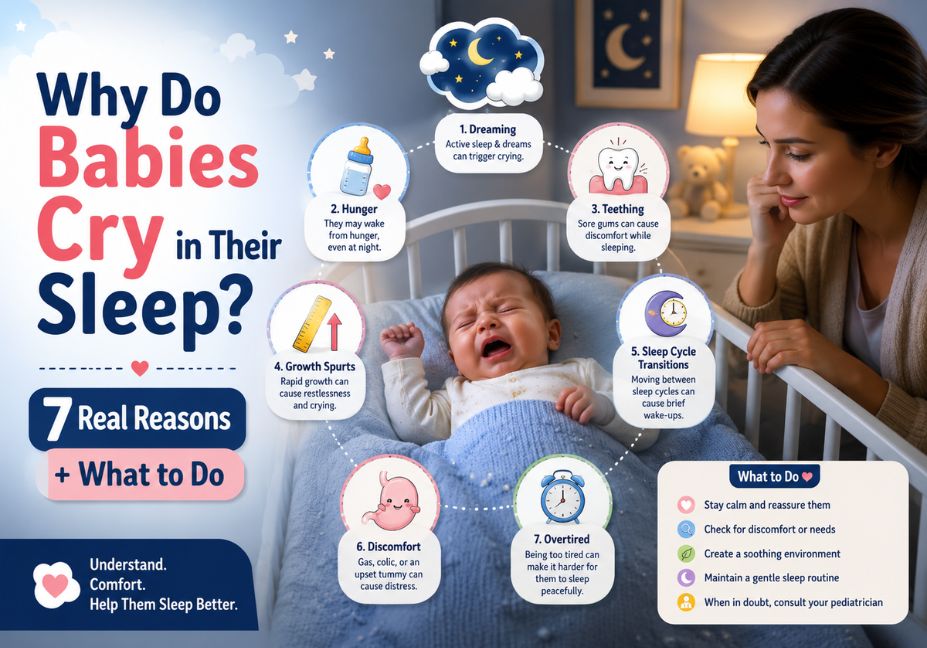
7 Reasons Why Babies Cry in Their Sleep
1. Active Sleep (REM Sleep)
This is the single most common reason newborns cry in their sleep. As the Sleep Foundation explains, newborns spend close to 50% of their sleep in active (REM-like) sleep — far more than adults, who spend only about 20–25%.
During this high-brain-activity phase, babies may flutter their eyelids, make sucking motions, twitch their arms and legs, and let out brief cries or whimpers.
💤 Did You Know? A healthy full-term infant’s average sleep cycle lasts only about 47 minutes, compared to 90 minutes in adults (NIH/PMC, 2012). This means babies cycle back into light, active sleep — and its associated cries — far more frequently than grown-ups do.
2. Sleep Cycle Transitions
Every 45–60 minutes, a sleeping baby moves between deep sleep and light sleep. During these transitions, they are briefly in a semi-awake state — and this is when crying often escapes.
Most of the time, the baby settles right back into the next cycle without ever fully waking. If crying lasts less than 5–10 minutes and fades on its own, it’s almost always a normal transition cry.
3. Hunger
Newborns have tiny stomachs and burn through milk quickly. Breastfed babies typically feed every 2–3 hours; formula-fed babies every 3–4 hours. When hunger builds during sleep, crying is the only tool a baby has to communicate it.
Look for hunger cues alongside the crying: rooting (turning head, searching for nipple), sucking motions with the mouth, and clenching fists.
✔️ Pro Tip: If your baby’s last feed was more than 2–3 hours ago and the crying escalates (doesn’t fade in a few minutes), hunger is likely the culprit. Offer a feed before assuming another cause.
4. The Moro (Startle) Reflex
The Moro reflex is an involuntary motor response present in all healthy newborns. A sudden noise, movement, or even a shift in sleep position can trigger it — causing the baby to fling out their arms and legs and then pull them back in, often accompanied by a sharp cry.
This reflex typically fades between 3–6 months as the nervous system matures. Swaddling is one of the most effective ways to reduce Moro-triggered crying at night.
5. Physical Discomfort (Gas, Teething, Illness)
Physical discomfort is a major driver of nighttime crying. Common culprits include gas or bloating, where trapped gas causes sharp abdominal pain that can wake even a deeply sleeping baby. Teething gum soreness intensifies at night when distractions disappear, with most babies beginning to teethe between 4 and 7 months. Illness or fever from a cold, ear infection, or mild virus can also cause discomfort that surfaces during sleep.
⚠️ Doctor’s Note: If your baby has a fever above 100.4°F (38°C), is unusually difficult to settle, or seems in significant pain, consult your paediatrician. Persistent crying during sleep can occasionally signal an ear infection or other condition needing treatment.
6. Sleep Regression or Developmental Leap
At predictable ages — most notably around 4 months, 6 months, and 9 months — babies undergo significant neurological development. These milestones temporarily disrupt sleep patterns, causing more frequent waking, fussing, and crying in sleep.
The 4-month sleep regression is especially well-known. Around this age, a baby’s sleep architecture permanently shifts to resemble adult patterns – which means more light sleep cycles and more opportunities for crying between them.
7. Sleep Associations
A sleep association is anything a baby relies on to fall asleep – being rocked, nursing, or a dummy. When they cycle into light sleep and that association is missing, they may cry out in search of it.
Medical News Today notes that this is one of the most common reasons for frequent nighttime crying in babies over 3–4 months old. Gradually helping a baby learn to fall asleep independently (self-soothing) can significantly reduce association-based crying.
Quick Reference: Crying in Sleep by Age
0–3 months — Most Common Cause: Active (REM) sleep, Moro reflex, hunger — What Helps: Swaddling, feeding on demand, white noise
3–6 months — Most Common Cause: Sleep cycle transitions, gas, teething begins — What Helps: Burping well, teething toys, consistent bedtime
4–6 months — Most Common Cause: 4-month sleep regression — What Helps: Patience: this phase passes in 2–6 weeks
6–12 months — Most Common Cause: Sleep associations, teething, developmental leaps — What Helps: Gradual self-soothing practice, comfort object
12+ months — Most Common Cause: Night terrors, separation anxiety, illness — What helps: Reassurance, consistent routine, a paediatrician if needed
Should You Pick Up Your Baby? When to Intervene vs. Wait
This is the question parents struggle with most. Here’s a simple framework.
⏸️ Pause First (30–60 seconds): When you hear your baby cry in their sleep, resist the urge to rush in immediately. Watch and listen. Is the crying fading or escalating? Many sleep cries resolve on their own within a minute.
Respond if crying escalates and does not fade after 5–10 minutes; your baby appears to be fully awake with eyes open and intensifying cries; you suspect hunger, illness, or significant discomfort; or there are signs of fever or unusual behaviour.
visible, waits and observes if crying lasts less than 5 minutes and gradually quiets, the baby’s eyes remain closed, the last feed was recent, no discomfort signs are visible, or the baby resettles into deeper sleep on their own.
How to Reduce Crying in Sleep: 5 Evidence-Based Tips
While some sleep crying is simply part of normal infant development, a few adjustments to your baby’s sleep environment and routine can make a real difference.
Swaddle newborns (0–3 months): Swaddling mimics the womb and suppresses the Moro reflex, reducing startle-triggered cries. Always follow safe sleep guidelines from the AAP.
Use white noise: Consistent background sound masks sudden environmental noises that trigger the Moro reflex or light sleep crying.
Establish a consistent bedtime routine: A predictable sequence (bath, feed, dim lights, sleep) helps calibrate the circadian rhythm and promotes deeper, more settled sleep.
Watch for overtiredness: Putting a baby down before they are overtired leads to easier sleep and less night crying. Look for early sleepy cues like yawning, eye-rubbing, or looking away.
Practise independent sleep skills (4+ months): Gently encouraging a baby to fall asleep on their own — even just for the first sleep of the night — reduces reliance on sleep associations and decreases mid-cycle crying.
FAQ — People Also Ask
Is it normal for babies to cry in their sleep?
Yes, completely normal. A study published in the NIH’s PMC database found that healthy full-term infants spend a significant portion of sleep in active (REM-like) sleep, during which brief cries, twitches, and facial expressions are expected. In most cases, sleep-crying is a developmental milestone, not a cause for concern.
Why do babies cry in their sleep without waking up?
Babies cry in their sleep without waking because they are in active sleep – a lighter, high-brain-activity stage where the body reacts to internal stimuli. Unlike deep sleep, active sleep involves movement, vocalisation, and even crying, all while the baby remains asleep. This is especially common in newborns, who enter active sleep almost immediately after falling asleep.
Should I pick up my baby when they cry in their sleep?
Not immediately. Paediatric sleep experts recommend pausing for 30–60 seconds before responding. Many sleep cries resolve on their own as the baby transitions to the next sleep cycle. If crying escalates, lasts more than 5–10 minutes, or the baby appears fully awake, then intervening with comfort, feeding, or a nappy check is appropriate.
How do I know if my baby is awake or crying in their sleep?
Watch the eyes. A baby crying in their sleep typically has their eyes closed or barely open, and the crying tends to ebb and flow in intensity. A fully awake baby will have open eyes and escalating cries and will not resettle without intervention. Pause before going in — the pattern of the cry tells you a lot.
When does crying in sleep stop in babies?
For most babies, frequent sleep crying decreases significantly by 3–6 months as the circadian rhythm matures, REM sleep proportion decreases, and sleep cycles lengthen. By 6 months, many babies have established more consolidated sleep. However, developmental leaps, teething, and illness can cause temporary spikes at any age.
Conclusion
Hearing your baby cry in their sleep is one of those parenting experiences that never quite gets easier — but understanding it makes all the difference. The three most important takeaways: most crying in sleep is completely normal, driven by active (REM) sleep, sleep cycle transitions, or the Moro reflex. Pause before you rush in—give your baby 30–60 seconds, as many cries resolve on their own. If sleep crying is frequent, intense, or paired with other symptoms, trust your instincts and speak with your paediatrician.
You’re not doing anything wrong. Babies cry in their sleep because their brains are developing at a remarkable pace – and that busy little brain is working hard even at rest.
⚠️ Medical Disclaimer: This article is for informational purposes only and does not substitute professional medical advice. Always consult your doctor or paediatrician before making changes to your baby’s sleep routine or if you have concerns about your child’s health.