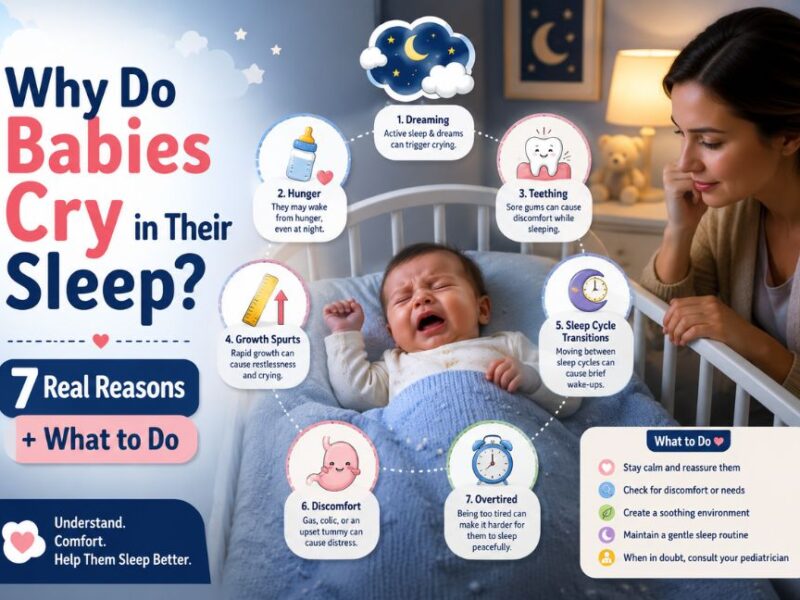

1. Sleep Cycle Transitions (Most Common in All Ages)
Why Does My Baby Cry in Her Sleep? The most frequent reason for sleep crying is simply the transition between sleep stages. As your baby shifts from deep quiet sleep to lighter active sleep, she partially rouses. Most babies whimper, fuss for 20–60 seconds, then settle back without fully waking.
This peaks around 2–4 months, when sleep cycles are maturing but haven’t fully organised yet. Many parents mistake this normal transition fussing for a full night-waking that needs intervention — and by rushing in, they actually interrupt a natural return to sleep.
| Pro TipAlways wait 30–60 seconds before responding to sleep crying. Many babies will settle themselves. Responding immediately can reinforce the need for your help to return to sleep — creating a sleep association. |
2. Hunger (Especially in Newborns)
Newborns have tiny stomachs and need to feed every 2–3 hours, including overnight. A hunger cry during sleep tends to escalate — it starts as whimpering, grows louder, and the baby will usually fully wake and root or turn her head. Unlike transition fussing, hunger doesn’t resolve itself in under a minute.
Why Does My Baby Cry in Her Sleep?
3. The Moro (Startle) Reflex
In the first 3–4 months, babies have a pronounced Moro reflex — an involuntary response where sudden movement or sound causes them to fling their arms wide and cry out. During active sleep, small muscle movements can trigger the Moro reflex, startling them into a brief, sharp cry. This is entirely normal and typically fades by 3–6 months of age.
4. Teething Pain
Teething can start as early as 3 months, though most babies cut their first tooth between 6–10 months. Gum discomfort often feels more intense at night when there are fewer distractions. Signs it’s teething: drooling during the day, swollen gums, hand-to-mouth chewing, and crying that responds to gentle gum massage or a chilled teether.
5. The 4-Month Sleep Regression
Around 4 months, a baby’s sleep architecture permanently shifts to more closely resemble adult patterns — with more distinct sleep stages and lighter transitions. This change, often called the 4-month sleep regression, can cause previously good sleepers to suddenly wake and cry frequently. It’s a sign of healthy neurological development, not regression in the negative sense.
| Expert NoteThe 4-month regression is one of the most researched and well-documented infant sleep disruptions. It’s not caused by anything you’re doing wrong — it’s a permanent maturation of the sleep cycle. Building independent sleep skills (learning to fall asleep without props) before or just after this window can significantly reduce night-waking going forward. |
6. Developmental Leaps
Throughout the first year, babies go through rapid periods of brain development — often called developmental leaps. During and just after these leestimation periods (commonly around 3, 6, 8, and 10 months), overtiredness and cognitive processing can make sleep lighter and more disrupted. Crying during sleep spikes temporarily before settling again.
Why Does My Baby Cry in Her Sleep?
7. Physical Discomfort — Gas, Reflux, or Illness
Gas bubbles, acid reflux, a wet nappy, or early illness can cause discomfort that registers during light sleep. Reflux in particular can cause a baby to cry when laid flat, as horizontal posture amplifies discomfort. If your baby regularly arches her back, spits up frequently, or cries more when horizontal, speak to your paediatrician. As Children’s Hospital Colorado notes, if a baby is losing weight or spitting up excessively, that warrants a prompt paediatric consultation.
[Insert image: mother soothing baby at night — Alt text: ‘Mother comforting baby crying in sleep — nighttime soothing techniques’]
Normal Sleep Crying vs. Nightmares vs. Night Terrors: The Definitive Comparison
One of the biggest gaps in competitor articles is the confusion between these three. Here’s a clear breakdown:
| Factor | Normal Sleep Crying | Nightmares | Night Terrors |
| Sleep stage | REM / cycle transitions | REM (active sleep) | Deep non-REM sleep |
| Typical age | Newborn–12 months+ | 6 months+ (older toddlers) | 18 months–7 years |
| Eyes | Closed, fluttering | May open on waking | Open but glazed, unseeing |
| Wakes fully? | Often settles on own | Yes — and upset | No — usually returns to sleep |
| Remembers event? | No | Yes (older toddlers) | No |
| What to do | Wait 30–60 sec, then soothe | Comfort, reassure | Stay calm, don’t wake |
Key distinction: Night terrors — rare in babies under 18 months — happen in deep non-REM sleep. Your baby won’t remember them, may scream or thrash but won’t respond to you, and will fall back into deep sleep. Nightmares happen in REM sleep and usually cause full waking with visible distress. For most babies under 12 months, what parents are seeing is normal sleep cycling, not nightmares or night terrors.
Baby Crying in Sleep: What to Expect at Every Age
Newborn (0–3 months)
Almost all sleep crying in newborns is normal. Their sleep is predominantly active (REM) sleep, their cycles are short, and they have no ability to self-soothe yet. Expect frequent fussing, grunting, and brief cries — this is biology, not distress. The National Sleep Foundation notes that newborns sleep 10.5–18 hours a day in multiple short bursts, with active movements and sounds throughout.
3–6 Months
Sleep becomes slightly more organised. The 4-month regression typically hits in this window. You may notice more frequent night crying as cycles shift. This is also when the Moro reflex begins to fade, which can reduce startle-related crying. Introducing a consistent bedtime routine now can help lay the foundation for better sleep.
6–12 Months
Teething begins. Separation anxiety emerges around 6–8 months as babies develop object permanence — the understanding that you exist even when out of sight. A baby who briefly stirs and realises you’re not there may cry out. Sleep associations (needing you to be present to fall back asleep) become more entrenched. This is a key window for gently supporting independent sleep skills.
Why Does My Baby Cry in Her Sleep?
12 Months+
Toddlers begin having more vivid dreams and, eventually, nightmares. Night terrors can begin as early as 18 months. Overtiredness from skipped naps or later bedtimes is one of the biggest drivers of sleep crying at this age. A consistent schedule with an age-appropriate nap and a predictable bedtime routine is the most evidence-based tool available.
What Should You Do When Your Baby Cries in Her Sleep?
- Wait 30–60 seconds first. Many babies will settle without you. Intervening immediately can interrupt a natural cycle transition.
- Observe, don’t assume. Is she fully awake? Are her eyes open or closed? Is the crying escalating or fading? Eyes closed + fading cry = still asleep, likely settling.
- If she needs you, go gently. Speak softly before touching — your voice can often shift her into a calmer sleep stage without fully waking her.
- Check for comfort basics. A dirty nappy, hunger, cold feet, or teething pain — rule these out if crying continues.
- Don’t wake her during a night terror. If she’s screaming but clearly not ‘there’ — eyes glazed, unresponsive to your voice — let it pass. Waking during a night terror causes more distress, not less.
- Follow safe sleep guidelines. Always follow safe sleep guidance from the American Academy of Pediatrics — back to sleep, firm flat surface, no loose bedding.
| Medical DisclaimerThis article is for informational purposes only and does not substitute professional medical advice. If your baby shows signs of illness, pain, significant weight loss, or you are concerned about their health or sleep, always consult your paediatrician or healthcare provider. |
When to Call Your Pediatrician
Most sleep crying is normal. But contact your baby’s doctor if:
- Crying during sleep is accompanied by fever, tugging at ears, or changes in feeding — these can signal an ear infection or illness.
- Your baby is crying more than 3 hours a day, 3+ days a week — this meets the clinical definition of colic (Mayo Clinic), which peaks around 6 weeks.
- Arching back, excessive spitting up, or refusing feeds — possible reflux requiring paediatric input.
- Episodes of rigid limbs, convulsing, or unresponsiveness — may indicate seizure activity, not sleep crying.
- Night crying that is getting significantly worse, not better, over weeks — especially if it’s affecting the family’s ability to function.
FAQ — People Also Ask
Why does my baby cry in her sleep without waking up?
This is called active sleep crying — a normal feature of infant REM sleep. Your baby’s brain is highly active during this phase, and the incomplete muscle paralysis of infant sleep allows small physical and vocal responses to internal brain activity. Most episodes last under 60 seconds and resolve without the baby fully waking. It peaks in the newborn and early infant stages and gradually decreases as sleep cycles mature.
Should I pick up my baby when she cries in her sleep?
Not immediately. Paediatric sleep experts recommend waiting 30–60 seconds to see if your baby settles on her own. Many sleep cries are part of a natural cycle transition that resolves without intervention. If the crying escalates, continues, or your baby fully wakes, then respond — check for comfort needs and offer gentle reassurance. Consistently picking up at the first sound can create sleep associations that make independent settling harder over time.
Is my baby having a nightmare or a night terror?
Nightmares occur during REM (active) sleep and typically cause a baby to wake fully, appearing distressed and needing comfort. Night terrors occur in deep non-REM sleep — your baby may scream, thrash, or appear awake but won’t respond to you and won’t remember the episode. Night terrors are rare before 18 months. Most crying in babies under 12 months is normal active sleep fussing, not a nightmare or night terror.
Why does my newborn cry in her sleep?
Newborns spend up to 50% of their sleep in active (REM) sleep — compared to 20% in adults. During this phase, sucking motions, twitching, facial expressions, and brief cries are entirely normal. Newborns also lack the neurological maturity to transition smoothly between sleep stages, so light-sleep moments are noisier and more active. This is healthy brain development, not distress.
When should I call the paediatrician about my baby crying in sleep?
Call your paediatrician if crying is accompanied by fever, ear-tugging, arching back, significant spitting up, or refusal to eat. Also seek advice if crying lasts more than 3 hours daily (possible colic), if episodes involve rigid or convulsing limbs, or if your family’s sleep is severely and consistently disrupted. Trust your instincts — if something feels different or wrong, a call to your child’s doctor is always the right move.
The Bottom Line
When your baby cries in her sleep, she’s almost certainly doing exactly what her developing brain is supposed to do — cycling through active REM sleep, processing the world, and occasionally fussing at the seams between sleep stages. It’s noisy, it’s startling, and it’s completely normal in the vast majority of cases.
The most useful thing you can do is learn your baby’s sleep patterns, wait before responding, and trust that each phase — the newborn haze, the 4-month regression, the teething nights — is temporary. Understanding the science behind your baby’s sleep won’t make the nights shorter, but it will make them far less frightening.
Bookmark this guide and explore more evidence-based parenting content at healthlinesignals.com.