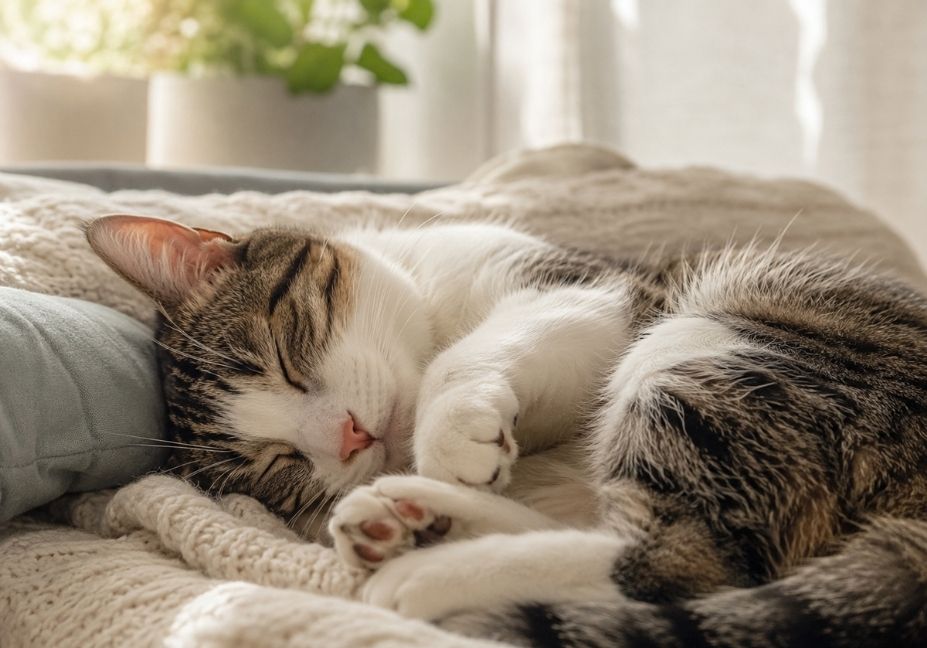
Cat parents everywhere know the scene: your cat is curled up mid-nap when suddenly a paw twitches, a whisker flutters, or a soft chirp escapes — and you’re left wondering why cats jerk when sleeping. The short answer is that it’s almost always a normal part of feline sleep, tied to the same dreaming stage that humans experience. Cats cycle through light sleep, deep sleep, and REM (rapid eye movement) sleep throughout the day, and it’s during REM that the brain lights up and the body sometimes twitches along with it.
Sleep researcher Michel Jouvet’s mid-century experiments on cats were among the first to map exactly how the brain switches muscles on and off during dreaming, and much of what veterinarians know about feline sleep twitching traces back to that work. Below, we’ll break down the mechanism behind cat sleep jerking, why kittens twitch more than adult cats, and the handful of warning signs that mean it’s time to call the vet instead of just smiling at the cute paw paddle.
What Is Cat Sleep Twitching?
‘Cat sleep twitching’ is the general term for the small, involuntary movements — paw twitches, ear flicks, whisker quivers, tail flicks, and occasional soft vocalisations — that show up while a cat is asleep, most often during REM sleep. REM sleep is generally defined as the stage marked by rapid eye movement, reduced muscle tone, and vivid dreaming, and cats move through a version of this cycle much like people and dogs do. The main difference is timing: a cat’s full sleep cycle runs about 104 minutes on average, cycling between light sleep, deep sleep, and REM several times during one long nap, so twitching can show up more than once per sleep session.
How Does Cat Sleep Twitching Actually Work?
During REM sleep, a cat’s brain fires many of the same signals it would use while stalking a bird or pouncing on a toy. Normally, a safety switch in the brainstem – centred on a region called the pons – keeps the muscles in a state of near-total relaxation known as ‘muscle atonia’, which is why a dreaming cat doesn’t leap off the couch mid-dream. Researchers have traced this atonia to inhibition of the spinal motor neurones that would otherwise carry out the brain’s movement commands, based on decades of landmark cat sleep study work.
Why Do Cats Jerk When Sleeping?
Michel Jouvet discovered the underlying mechanism in the 1960s when he found that cats with damage to this brainstem circuit acted out their dreams in real time — walking, stalking, and grooming while still fully asleep, a behaviour he termed ‘oneiric behaviour’. In healthy cats, a few signals slip past the atonia switch anyway, and that’s the twitch you see: a paw jerk, an ear flick, or a whisker quiver riding along with the dream.
| Did You Know? A cat’s REM cycle lasts only about six minutes at a time — much shorter than a human’s — so harmless sleep twitching tends to be a brief event rather than a long stretch of movement. |
Why Do Cats Jerk When Sleeping? The Top Reasons
There isn’t just one explanation — several overlapping factors can cause a cat to twitch mid-nap.
- Dreaming during REM sleep — the most common cause; the brain replays hunting, playing, or exploring.
- Hypnic jerks at sleep onset — a sudden, startle-like twitch as the cat first drifts off, similar to the sleep starts people feel.
- A developing nervous system in kittens — covered in more detail below.
- Post-surgical or medication side effects — occasionally reported after anaesthesia or certain drugs; always check with a vet before adjusting any medication.
- Mild irritation from fleas or allergies — some cats scratch or twitch in response to itchy skin even while resting.
Why Do Cats Jerk When Sleeping?
| Pro Tip: Keep a simple sleep log for a week, noting when twitching happens, how long it lasts, and how your cat behaves afterward. That pattern is exactly what a vet will want to hear if you ever need to bring it up. |
Kittens vs. Adult Cats: Why Younger Cats Twitch More
Kittens spend a larger share of their sleep in REM than adult cats do, and their nervous systems are still under construction. That extra twitching is sometimes called activated sleep — a stage where the brain fires off small, spontaneous movements that help strengthen developing muscles and neural connections. You might notice paws paddling, ears flicking, or tiny sounds, all part of normal growth. As kittens mature into adulthood, this twitching typically settles down, though most adult cats still show some movement during REM sleep.
Normal Twitching vs. Seizures: How to Tell the Difference
Most sleep twitching is brief, mild, and confined to one part of the body. Seizures look and behave differently. The comparison below can help you tell them apart at a glance:
| Feature | Normal Sleep Twitching | Possible Seizure |
| Duration | A few seconds to a couple of minutes | Often prolonged, may repeat in clusters |
| Body involved | Localized — a paw, whisker, ear, or tail | Often the whole body, sometimes rigid or convulsive |
| Response to waking | Wakes normally, may seem startled | May not respond normally when woken |
| After the episode | Continues sleeping or wakes calmly | Disorientation, drooling, or confusion possible |
| Happens while awake? | No | Sometimes, yes |
| Doctor’s Note: Veterinary sleep experts point out that the clearest way to catch anything abnormal is knowing your own cat’s normal sleep habits well enough to notice when something changes — consistency is more useful than any single checklist. |
When to Call the Vet
Occasional, mild twitching during sleep is rarely a reason for concern. Contact your veterinarian if you notice any of the following:
- Twitching that continues after your cat is fully awake
- Full-body convulsions, stiffness, or loss of balance
- Drooling, disorientation, or confusion after an episode
- Twitching that started right after a new medication or a surgical procedure
- Skin rippling combined with sudden agitation or excessive licking, which can point to feline hyperesthesia syndrome
For comparison, people experience the same kind of jolt people feel when drifting off to sleep, known as a ‘hypnic jerk’ — a normal, harmless startle that is a close human parallel to a cat’s sleep-onset twitch.
What Real Cat Owners Say
Plenty of cat owners describe on Quora the same experience: their cat’s paws twitch as if chasing something in a dream, and after comparing notes with other pet parents, most conclude their cat is simply deep in a good dream rather than in any distress.
FAQ: People Also Ask
Why Do Cats Jerk When Sleeping?
Is it normal for a cat to twitch while sleeping?
Yes. Most cats twitch occasionally during REM sleep as their brain processes a dream-like state. Paw movements, whisker twitches, and small vocalisations are considered a normal, healthy sign of deep rest rather than a health problem.
Should I wake my cat up if it’s twitching?
No, it’s best to let a twitching cat sleep undisturbed. Waking a cat mid-REM sleep can startle it the way waking a dreaming person does, and normal twitching resolves on its own within a few minutes.
What’s the difference between cat twitching and a seizure?
Normal twitching is brief, localised to a paw or whisker, and stops as soon as the cat wakes. A seizure typically involves the whole body, may include stiffness or drooling, and the cat may seem disoriented or unresponsive afterward.
Why Do Cats Jerk When Sleeping?
Why do kittens twitch more than adult cats?
Kittens spend more time in REM sleep because their nervous systems are still developing. This activated sleep helps build muscle coordination and neural connections, and it typically decreases as the kitten matures.
Can cats have nightmares?
It’s hard to know for certain, but researchers who study feline sleep behaviour believe cats experience something similar to dreaming, including scenarios that could resemble unpleasant dreams. Occasional distressed sounds during sleep don’t necessarily mean anything is wrong.
What is feline hyperaesthesia syndrome?
Feline hyperaesthesia syndrome is an uncommon condition involving skin rippling, sudden agitation, or self-directed biting, sometimes confused with simple twitching. It differs from ordinary sleep movement and is worth discussing with a vet if you notice these signs while your cat is awake.
Conclusion
In most cases, cat sleep twitching is simply a sign of a healthy brain cycling through REM sleep and a dream-filled nap. The paw twitches, whisker quivers, and occasional tiny chirps are part of the same dreaming process researchers first documented in cats decades ago, and kittens naturally show more of it while their nervous systems mature. The key is knowing your own cat’s normal sleep habits well enough to notice a change — full-body convulsions, twitching that continues after waking, or confusion afterward are the signals that warrant a vet visit. For everyday sleep twitches, though, the safest and kindest response is simply to let your cat dream in peace.
Why Do Cats Jerk When Sleeping
Bookmark this guide and explore more evidence-based pet health content at healthlinesignals.com.
| Medical Disclaimer: This article is for informational purposes only and does not substitute professional veterinary advice. Consult your veterinarian if you have concerns about your cat’s health. |