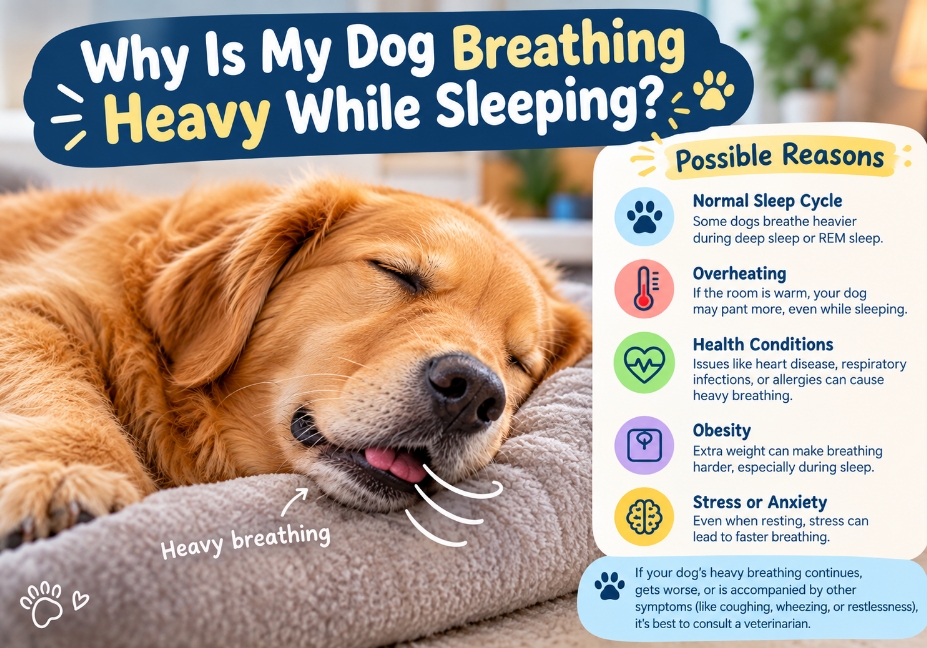
Why Is My Dog Breathing Heavy While Sleeping? You glance over at your sleeping dog and notice their sides heaving faster than usual, or their breathing sounding louder or more labored than it normally does. It’s easy to jump straight to worst-case scenarios, but heavy breathing during sleep has a wide range of causes — many completely harmless, a few that genuinely warrant a vet visit. The good news is that this is one of those situations where a simple at-home check can tell you a lot.
What’s Normal First
A resting or sleeping adult dog typically takes somewhere between 15 and 30 breaths per minute. Puppies and smaller breeds tend to run a bit faster due to quicker metabolisms. Knowing your own dog’s normal resting rate — checked on an ordinary, calm day — gives you a real baseline to compare against if something ever seems off.
How to count it: Watch your dog’s chest rise and fall for 15 seconds, count the breaths, then multiply by four. Doing this once when your dog is healthy gives you a useful reference point for the future.
The Harmless Explanation: Dreaming
Dogs cycle through REM (rapid eye movement) sleep just like people do, and it’s common for breathing to speed up or become slightly irregular during this stage as the brain processes a dream. This kind of heavy breathing is usually accompanied by other classic dreaming signs — twitching paws, faint barks or whimpers, or paddling legs, as if running. If the faster breathing settles back to normal once your dog moves into a deeper sleep stage, and they wake up acting completely normal, dreaming is almost certainly the explanation.
Why Is My Dog Breathing Heavy While Sleeping?
Did you know? In this context, “heavy breathing” and true labored breathing look and sound different. Dream-related breathing changes are usually rhythmic and resolve on their own, while labored breathing tends to look strained, with visible extra chest or belly effort, and doesn’t self-correct.
Other Everyday, Low-Concern Causes
- A warm room. Dogs regulate temperature partly through panting, and an overly warm bedroom or too many blankets can lead to heavier breathing even at rest.
- Stress or a new environment. An unfamiliar setting, recent move, or a stressful day can carry over into more labored-sounding breathing during sleep.
- Brachycephalic (flat-faced) breeds. Breeds like Pugs, Boston Terriers, Bulldogs, and Boxers have naturally narrower airways due to their skull shape, a condition sometimes called brachycephalic obstructive airway syndrome. Heavier, noisier breathing — even during ordinary rest — is common in these breeds and isn’t automatically a red flag, though it’s still worth discussing baseline breathing patterns with your vet.
When It Could Signal Something More Serious
This is the part worth taking seriously, because heavy breathing during rest or sleep can be an early warning sign of underlying heart or lung disease — sometimes showing up before more obvious symptoms appear. Veterinarians specifically track something called sleeping respiratory rate (SRR) in dogs being monitored for heart disease, because a rising SRR can be one of the earliest signs that fluid is beginning to build up in the lungs, a condition linked to congestive heart failure.
Signs that heavy breathing may be more than just dreaming or a warm room:
- A resting respiratory rate consistently above 30 breaths per minute
- Labored breathing — visibly increased effort, with the chest or belly working harder than normal
- Persistent panting that doesn’t resolve with rest or cooling down
- Coughing, especially if it’s new or persistent
- An outstretched neck or obvious difficulty getting comfortable
- Pale, bluish, or grayish gums — a sign the body isn’t getting enough oxygen
- Lethargy or weakness, particularly upon waking
- Fainting or collapse
Why Is My Dog Breathing Heavy While Sleeping?
Expert note: Veterinarians note that persistent heavy breathing at rest — not tied to exercise, heat, or an obvious dream — deserves a prompt evaluation, since possible causes range from heart disease and lung conditions to anemia, pneumonia, or even pain from an injury like a fractured rib.
What to Do If You’re Concerned
- Count the breaths. Fifteen seconds, times four, gives you breaths per minute — this single number is one of the most useful things you can report to your vet.
- Watch for a pattern. Note whether the heavy breathing happens consistently, only during certain sleep stages, or alongside specific triggers like heat or a stressful day.
- Check the gums. Healthy gums are pink; pale, blue, or gray gums are an emergency sign that needs immediate veterinary attention.
- Keep them calm and comfortable. If your dog seems to be in respiratory distress, minimize activity, keep them in a cool, quiet space, and head to the vet rather than waiting it out.
- Don’t wait on a rising trend. If sleeping respiratory rate has been creeping upward over days or weeks, especially in an older dog or one with a known heart condition, contact your vet rather than assuming it will resolve on its own.
Pro tip: If your dog has a diagnosed heart condition, your vet may specifically ask you to track sleeping respiratory rate at home as an early-warning system — a rising number, even without other symptoms yet, is often reason enough to call in.
Frequently Asked Questions/Why Is My Dog Breathing Heavy While Sleeping?
What’s a normal breathing rate for a sleeping dog?
Generally 15 to 30 breaths per minute for an adult dog at rest. Anything consistently above 30, or breathing that looks visibly labored, is worth mentioning to your vet.
Can dreaming cause my dog to breathe heavily in their sleep?
Yes. Breathing often speeds up or becomes irregular during REM sleep, usually alongside twitching or soft vocalizing. It should settle back to normal breathing once the dream passes.
How can I tell if my dog’s heavy breathing is serious?
Look for a resting rate consistently above 30 breaths per minute, visibly labored breathing, coughing, pale or bluish gums, lethargy, or collapse. Any of these warrant prompt veterinary evaluation.
Are certain dog breeds more prone to heavy breathing?
Yes. Flat-faced (brachycephalic) breeds like Pugs, Bulldogs, and Boxers have narrower airways and tend to breathe more heavily even at baseline, though it’s still worth establishing what’s normal for your individual dog.
Why do vets ask about my dog’s sleeping respiratory rate?
In dogs with known or suspected heart disease, a rising sleeping respiratory rate can be one of the earliest signs of fluid building up in the lungs, often before other symptoms appear — making it a useful early-warning tool.
The Bottom Line
Heavy breathing in a sleeping dog is very often nothing more than a vivid dream, a warm room, or a naturally narrower airway in certain breeds. The exception worth taking seriously is a resting breathing rate that’s consistently elevated, labored, or paired with symptoms like coughing, pale gums, or lethargy — all of which can point to heart or lung issues that benefit from early evaluation. When in doubt, counting your dog’s breaths for 15 seconds is a quick, genuinely useful way to know whether it’s time to call the vet.
This article is for informational purposes only and does not substitute for professional veterinary advice. If you have concerns about your dog’s breathing, consult your veterinarian.